

APFC Panel Manufacturer
Industrial electrical systems require different types of panels for managing power quality, electrical distribution, generator operation, and connected loads. APFC and AMF Panels perform two very different functions: an APFC panel manages power factor by controlling capacitor stages, while an AMF panel manages automatic changeover between the mains supply and a standby generator. Yuva Solution provides customized APFC Panel Manufacturer for industrial, commercial, infrastructure, and utility applications across Kolkata, Bihar, Odisha, Jharkhand, Chhattisgarh, and Assam.
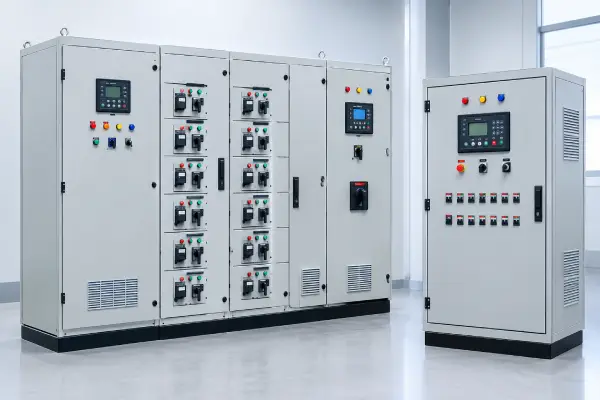
Product Overview
APFC Panel
APFC stands for Automatic Power Factor Correction. An APFC Panel automatically controls capacitor banks to compensate for reactive power in an electrical system and maintain the power factor around a desired level.
Industrial loads such as motors, transformers, pumps, compressors, and other inductive equipment can consume reactive power. The APFC panel monitors the electrical system and switches capacitor stages in or out according to the requirement.
A typical APFC system may include:
- APFC relay/controller
- Capacitor banks
- Capacitor-duty contactors
- MCCB/MCB or suitable protection
- Busbars
- Current transformers
- Detuned reactors where required
- Indication lamps
- Multifunction meters
- Cooling arrangements
- Control wiring
The number and rating of capacitor stages are selected according to the electrical load and power-factor correction requirement.
AMF Panel
AMF stands for Automatic Mains Failure. An AMF Panel is used to manage the automatic starting and changeover sequence between the normal mains supply and a standby diesel generator when the configured mains-failure condition occurs.
The panel monitors the mains supply and, when appropriate conditions are detected, sends a start command to the generator. Once the generator reaches suitable operating conditions, the AMF system can transfer the connected load to the generator through the applicable switching arrangement.
When the mains supply is restored and remains stable for the configured period, the system can initiate the return changeover and generator shutdown sequence.
Detailed Working of an APFC Panel
The APFC panel continuously monitors electrical parameters through a suitable sensing arrangement.
When the power factor moves below the configured target, the APFC controller can connect an appropriate capacitor stage. If the reactive power requirement decreases, capacitor stages can be disconnected.
This automatic switching allows the capacitor bank to respond to changing electrical loads.
APFC Operating Sequence
Electrical Load → CT/Sensing → APFC Controller → Capacitor Switching → Reactive Power Compensation
The controller determines which capacitor stage should be connected or disconnected based on the measured electrical conditions and programmed switching logic.
Why APFC Panels Are Used
Maintaining an appropriate power factor can be important for industrial electrical systems because many installations operate large inductive loads.
An APFC panel can help with:
- Automatic capacitor switching
- Reactive power compensation
- Power-factor management
- Better utilization of electrical capacity
- Reduction of unnecessary reactive current
- Improved electrical system performance
The actual improvement depends on the load profile, capacitor sizing, harmonics, transformer capacity, and overall electrical system design.
APFC Panel Technical Specifications
APFC panel ratings are selected according to the installation rather than using one standard configuration.
Typical specifications may include:
- System voltage: commonly 415 V AC in industrial applications
- Frequency: generally 50 Hz
- Capacitor bank capacity: selected according to required kVAr compensation
- Number of capacitor stages: application dependent
- APFC controller: automatic multi-stage control
- Switching device: capacitor-duty contactors or suitable switching technology
- Incoming protection: MCCB or suitable protective device
- Current sensing: CT-based
- Busbar: copper or aluminium as per design
- Enclosure: suitable for indoor or outdoor installation
- Metering: power factor, voltage, current, kW, kVA, kVAr as required
- Harmonic mitigation: detuned reactors where required
Capacitor selection should consider the system voltage, load profile, harmonic environment, and required correction level.
APFC Panels for Harmonic-Rich Systems
Some industrial installations contain non-linear loads such as VFDs, UPS systems, rectifiers, and power electronic equipment. These loads can introduce harmonics into the electrical system.
In such installations, simply adding capacitors may not be sufficient. A suitable design may require detuned reactors or other harmonic-management measures.
The capacitor bank and reactor arrangement should therefore be selected after evaluating the electrical system and harmonic conditions.
AMF Panel – Detailed Overview
An AMF panel provides automatic control for mains and generator changeover.
It is commonly installed where uninterrupted or standby power is important for selected electrical loads.
The AMF controller monitors parameters of the mains supply and generator. When the configured mains-failure condition occurs, it can initiate the generator-starting sequence.
Typical AMF Sequence
Mains Available → Load on Mains
↓
Mains Failure Detected
↓
Generator Start Command
↓
Generator Reaches Suitable Voltage & Frequency
↓
Load Transfer to Generator
↓
Mains Restored
↓
Return Transfer to Mains
↓
Generator Cool-Down / Stop
The actual sequence and timing depend on the controller, generator control system, switching equipment, and project requirements.
Main Components of an AMF Panel
An AMF panel may incorporate:
- AMF controller
- MCCB/ACB or suitable switching devices
- Contactors where applicable
- Generator interface
- Mains sensing
- Voltage monitoring
- Frequency monitoring
- Control relays
- Timers
- Indication lamps
- Emergency stop interface
- Auto/manual selector
- Electrical interlocking
- Generator start/stop interface
- Metering instruments
Component selection depends on generator capacity, mains configuration, switching method, and connected load.
AMF Panel Technical Specifications
Typical design parameters may include:
- System voltage: commonly 415 V AC for three-phase industrial systems
- Frequency: generally 50 Hz
- Source: utility mains + standby DG
- Incomer arrangement: MCCB/ACB or suitable switching device
- Generator interface: compatible with DG controller
- Control supply: application dependent
- Changeover: automatic or manual/automatic configuration
- Electrical interlocking: as required
- Mechanical interlocking: where applicable
- Metering: voltage, current, frequency and other parameters as required
- Enclosure: selected according to installation environment
- Cable entry: top or bottom according to site requirements
The switching device ratings must be selected according to the generator capacity, load current, fault level, and applicable electrical design requirements.
APFC vs AMF Panel
Although both are electrical control panels, their purposes are completely different.
Parameter | APFC Panel | AMF Panel |
Full Form | Automatic Power Factor Correction | Automatic Mains Failure |
Main Purpose | Power-factor management | Mains-generator changeover |
Primary Equipment | Capacitor banks | Generator and switching equipment |
Main Function | Compensates reactive power | Transfers load during mains failure |
Controller | APFC relay/controller | AMF controller |
Sensing | Current/voltage/power factor | Mains and generator voltage/frequency |
Typical Application | Industrial power systems with inductive loads | Facilities requiring standby generator operation |
Main Benefit | Automatic reactive-power compensation | Automatic backup-power operation |
Common Applications of APFC Panels
APFC panels can be suitable for facilities with significant inductive electrical loads, such as:
- Manufacturing plants
- Steel plants
- DRI plants
- Textile industries
- Paper industries
- Cement plants
- Chemical industries
- Water treatment plants
- HVAC installations
- Commercial buildings
- Large workshops
- Infrastructure facilities
Common Applications of AMF Panels
AMF panels can be used wherever standby generator operation is required, including:
- Industrial plants
- Manufacturing units
- Commercial buildings
- Hospitals
- Data and communication facilities
- Warehouses
- Hotels
- Institutional buildings
- Water treatment facilities
- Infrastructure projects
- Utility installations
The connected loads and generator capacity should be assessed before selecting the appropriate AMF arrangement.
Quality You Can Trust
Reliable panel operation depends on correct engineering, component selection, assembly, wiring, protection, and testing.
Yuva Solution can focus on:
- Proper component selection
- Organized internal wiring
- Suitable protection
- Correct capacitor-stage arrangement
- Appropriate busbar sizing
- Clear component identification
- Electrical interlocking
- Panel accessibility
- Functional checking
- Documentation according to project requirements
For APFC systems, capacitor banks and switching equipment should be selected with consideration for the electrical environment. For AMF systems, the mains, generator, and load-transfer arrangement should be coordinated properly.
Why Choose Yuva Solution?
Yuva Solution develops electrical panels according to the actual requirements of the installation rather than using a single fixed configuration.
Our engineering approach can consider:
- Connected load
- Generator capacity
- Power-factor requirement
- Capacitor bank size
- Harmonic conditions
- Fault level
- Switching arrangement
- Protection requirements
- Panel dimensions
- Installation environment
- Metering requirements
This allows APFC and AMF panels to be configured for different industrial and commercial applications.
Infrastructure & Industrial Uses of APFC and AMF Panels
APFC and AMF panels can form important parts of an industrial electrical infrastructure.
APFC panels can be installed near electrical distribution systems to manage reactive-power requirements associated with suitable loads.
AMF panels can be used with standby DG sets to manage automatic source changeover for designated electrical loads.
Together, these panels can address different aspects of electrical system management—power-factor correction and backup-power control.
Service Locations
Yuva Solution provides APFC & AMF Panel solutions across:
- Kolkata
- Bihar
- Odisha
- Jharkhand
- Chhattisgarh
- Assam
Solutions can be developed for industrial plants, commercial establishments, infrastructure projects, engineering contractors, and other electrical installations.
Frequently Asked Questions
A PLC Control Panel contains a programmable logic controller and associated electrical components used to control and monitor industrial machinery or processes.
A Drive Control Panel houses suitable motor drives and supporting components used to control motors, including speed and operating functions where required.
A CNC Control Panel contains or interfaces with the electrical and control components required for operating CNC machinery according to its specific architecture.
Yes, where the application and electrical design permit it. A PLC can communicate with and control suitable VFDs for coordinated motor operation.
Yes. Panel dimensions, component selection, I/O configuration, drive capacity, protection, communication, and other features can be customized according to project requirements.
Yuva Solution serves customers across Kolkata, Bihar, Odisha, Jharkhand, Chhattisgarh, and Assam.
Contact Yuva Solution
If you need an APFC Panel for automatic power-factor management or an AMF Panel for reliable mains-to-generator changeover, Yuva Solution can develop a solution around your electrical system.
Frequently Asked Questions
A PLC Control Panel contains a programmable logic controller and associated electrical components used to control and monitor industrial machinery or processes.
A Drive Control Panel houses suitable motor drives and supporting components used to control motors, including speed and operating functions where required.
A CNC Control Panel contains or interfaces with the electrical and control components required for operating CNC machinery according to its specific architecture.
Yes, where the application and electrical design permit it. A PLC can communicate with and control suitable VFDs for coordinated motor operation.
Yes. Panel dimensions, component selection, I/O configuration, drive capacity, protection, communication, and other features can be customized according to project requirements.
Yuva Solution serves customers across Kolkata, Bihar, Odisha, Jharkhand, Chhattisgarh, and Assam.