Special Purpose Machines (SPM)
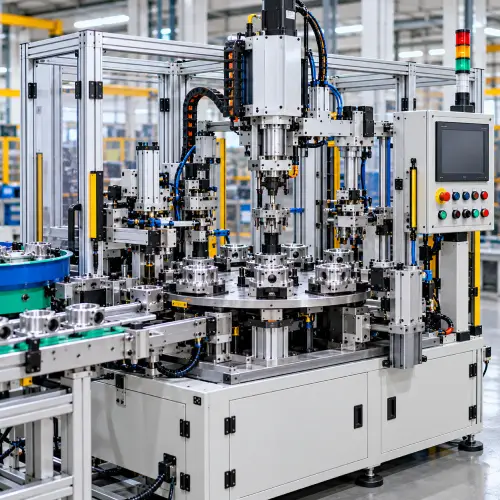
Special Purpose Machines (SPM) are customized industrial machines developed to perform specific manufacturing operations. Unlike general-purpose equipment, an SPM is designed around a particular production task, component, process, or workflow.
Yuva Solution develops SPM solutions according to the required operation and production environment. Depending on the application, an SPM can combine mechanical assemblies with motors, sensors, control panels, PLCs, drives, pneumatic or hydraulic systems, and operator controls.
These machines can be developed for applications such as assembly, drilling, cutting, pressing, feeding, inspection, component handling, or other repetitive manufacturing operations.
Key Features of SPM Manufacturing
- Application-specific machine design
- Customized mechanical arrangements
- Automated or semi-automated operation
- Integration of electrical and control systems
- Sensor-based process monitoring
- Improved production consistency
- Reduced repetitive manual intervention
- Adaptability to specific component requirements
Benefits of Special Purpose Machines
A properly designed SPM can help manufacturers create a more organized production process. Automation of repetitive tasks can improve cycle consistency and make production easier to monitor.
SPMs can also be developed with future expansion in mind, allowing manufacturers to incorporate additional sensors, controls, or automation functions when production requirements change.
Machine Modification
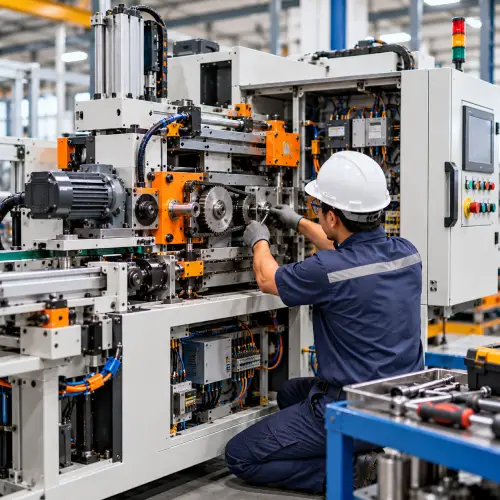
Machine Modification involves upgrading, altering, or redesigning selected parts of an existing industrial machine to meet new production requirements. This can be useful when a machine remains mechanically valuable but requires changes to its functionality, control system, working arrangement, or production capacity.
Yuva Solution provides machine modification solutions based on the existing equipment and the desired outcome. Modification work may involve mechanical changes, electrical upgrades, control-system alterations, fixture improvements, automation additions, or changes to machine operating sequences.
Instead of replacing an entire machine, selected systems can be modified where technically suitable.
Common Machine Modification Work
- Mechanical Alteration: Modification of machine structures, assemblies, fixtures, or working arrangements.
- Control System Upgrades: Updating outdated control components to support improved operation.
- Electrical Modification: Reworking panels, wiring, switching components, and machine circuits.
- Automation Integration: Adding PLCs, sensors, drives, HMIs, or other automation components.
- Fixture Modification: Developing or changing fixtures to accommodate different components.
- Process Improvement: Altering machine functions to suit revised manufacturing processes.
- Safety Improvements: Incorporating appropriate safety controls and protective mechanisms.
How Manufacturing Services Support Industrial Production
Industrial production requirements can change over time. A company may introduce a new component, increase output, modify its process, or require greater automation. Standard machinery may not always provide the flexibility needed for such changes.
Yuva Solution’s Manufacturing Services provide a way to address these requirements through customized engineering. SPMs can be developed for dedicated production tasks, while machine modification can help adapt existing equipment to changing operational needs.
This approach allows manufacturers to select a solution according to their actual production challenges rather than relying only on off-the-shelf machinery.