
Safety Controller Manufacturer
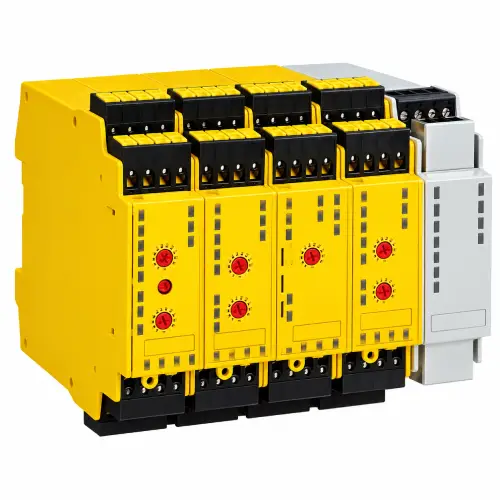
A Safety Controller is a specialized control device used to coordinate multiple safety functions within industrial machinery and automated equipment. It receives signals from safety devices, processes predefined safety logic, and controls safety-related outputs according to the designed machine-protection strategy. Unlike a conventional automation controller that primarily manages production operations, a safety controller is intended for safety-related functions and can bring different protective devices into one coordinated system.
Yuva Solution provides Safety Controller solutions for industrial automation and machine-safety requirements across Kolkata, Bihar, Odisha, Jharkhand, Chhattisgarh, and Assam. A safety controller can be used with suitable safety sensors, emergency-stop devices, guard switches, light curtains, safety scanners, and other compatible safety equipment.
Product Capabilities
Safety controllers are particularly useful when a machine has several safety devices that need to work together.
Depending on the model and system architecture, capabilities may include:
- Monitoring multiple safety inputs
- Processing safety-related control logic
- Managing emergency-stop functions
- Monitoring guard-door interlocks
- Connecting safety light curtains and scanners
- Controlling safety outputs
- Supporting multiple machine safety zones
- Providing diagnostic information
- Monitoring selected faults
- Communicating with compatible automation systems
- Supporting configurable safety functions
Programmable models can offer greater flexibility when a machine requires several safety conditions or different safety responses.
Top Benefits of Choosing Our Safety Controller
- Centralized Safety Management
Multiple safety devices can be brought into a coordinated safety-control architecture rather than relying on numerous independent circuits.
- Flexible Safety Logic
Where supported, programmable safety controllers allow safety functions to be configured according to the machine design.
- Easier System Expansion
A suitable controller can provide additional capacity for future safety devices or machine modifications, depending on the model.
- Clearer Diagnostics
Selected controllers provide diagnostic information that can help maintenance personnel identify the status or source of certain safety-related conditions.
- Multiple Safety Zones
Complex machinery may contain several hazardous areas. A suitable safety controller can manage safety functions associated with different zones.
- Integration With Automation
Safety controllers can operate alongside standard PLCs, HMIs, drives, and other automation equipment while maintaining the separation and interaction required by the safety architecture.
Fields of Operation
Safety controllers can be used across a broad range of automated machinery and industrial systems, including:
- Robotic cells
- Automated assembly lines
- Conveyor systems
- Packaging machinery
- Machine tools
- Automotive production
- Material-handling systems
- Printing machinery
- Pharmaceutical equipment
- Food-processing machinery
- Manufacturing plants
- Industrial processing equipment
- Automated warehouse systems
The controller configuration should be determined from the hazards and safety functions identified for the specific machine.
Precision Engineered Safety Controllers
A safety controller acts as the decision-making element of a safety system. It does not simply receive an input and switch an output; depending on the model, it can evaluate multiple safety conditions according to configured safety logic.
A typical architecture may look like:
Safety Sensors / E-Stops / Interlocks → Safety Controller → Safety Outputs → Machine Response
For example, an automated production cell may have several access doors, emergency-stop buttons, and a light curtain. A safety controller can monitor these inputs and implement the required safety response when one of the protective conditions is interrupted.
The actual safety response must be established through appropriate machine risk assessment and engineering.
Safety Controller vs Standard PLC
Safety Controller | Standard PLC |
Designed for safety-related control functions | Primarily designed for process and machine automation |
Used with safety-rated input devices | Normally handles standard automation inputs |
Provides safety-related logic according to its certification | Standard PLC logic is not automatically a safety function |
Can manage multiple safety devices | Mainly controls production processes |
May provide safety diagnostics | Provides conventional system diagnostics |
Used as part of a machine-safety architecture | Used for normal machine operation |
A standard PLC should not automatically be treated as a replacement for a certified safety controller where a safety-rated control function is required.
Technical Specifications
Safety controller specifications vary according to the model and manufacturer. Important parameters can include:
Parameter | Technical Consideration |
Controller Type | Safety controller / Programmable safety controller |
Safety Inputs | Number and type depend on model |
Safety Outputs | Number and type depend on model |
Auxiliary I/O | Model dependent |
Supply Voltage | Product specific |
Programming | Model/software dependent |
Communication | Ethernet / Fieldbus / Other, depending on model |
Safety Devices | E-stop, interlock, light curtain, scanner, etc. |
Response Time | Model and configuration dependent |
Mounting | DIN rail / Panel |
Diagnostic Functions | Model dependent |
Operating Temperature | Product specific |
Safety Performance | Must meet application requirement |
Expansion | Dependent on controller architecture |
Exact values should be verified against the technical datasheet of the selected safety controller.
Cost-Effective Safety Controllers for Commercial and Industrial Use
Choosing a safety controller involves more than comparing purchase prices. The controller should have sufficient capacity for the required safety functions and be compatible with the machine’s existing architecture.
Factors to consider include:
- Number of safety inputs
- Number of safety outputs
- Number of safety zones
- Required safety functions
- Communication requirements
- Programming requirements
- Existing PLC and automation system
- Machine stopping characteristics
- Future expansion
- Environmental conditions
For a machine with only a few safety functions, a compact solution may be adequate. More complex automated systems can benefit from programmable safety controllers with greater I/O and logic capabilities.
Safety Controllers: Revolutionizing Machine Protection
Industrial machinery is becoming increasingly interconnected, with robots, drives, conveyors, sensors, and controllers working together at high speed. This makes coordinated safety management increasingly important.
A safety controller can bring multiple safety inputs together and process them according to the machine’s safety strategy. This can help create a more organized safety architecture for complex automated equipment.
The goal is not simply to stop a machine but to ensure that defined safety conditions are monitored and the appropriate protective action occurs when required.
Where Safety Controllers Make a Difference
- Robotic Automation
A safety controller can coordinate protective devices around robotic cells and restricted operating zones.
- Packaging Lines
Multiple access doors, emergency stops, and protective devices can be managed within one safety architecture.
- Conveyor Systems
Safety devices distributed along a conveyor arrangement can be connected to suitable safety-control equipment.
- Automated Production Lines
Different machine sections can have individual safety conditions while remaining part of a coordinated safety system.
- Machine Tools
Safety controllers can be used with compatible guards, emergency stops, and other protective devices.
Why Choose Yuva Solution?
Yuva Solution provides Safety Controller solutions for customers across Kolkata, Bihar, Odisha, Jharkhand, Chhattisgarh, and Assam.
The company understands that safety requirements differ from one machine to another. Therefore, controller selection can be considered according to the number of safety devices, required logic, machine architecture, communication requirements, and future expansion plans.
Yuva Solution can assist with requirements involving:
- Safety Controllers
- Programmable safety controllers
- Safety input/output systems
- Machine-safety integration
- Safety sensor connectivity
- Safety relay and controller requirements
- Industrial automation safety applications
Building a Coordinated Machine-Safety System
A modern machine may contain several protective devices operating at different points. Bringing these devices into an appropriate safety-control architecture can simplify the overall safety design.
For example:
Emergency Stop + Guard Interlock + Light Curtain + Safety Scanner → Safety Controller → Defined Safe Response
This type of coordinated arrangement can be useful for machines where several safety conditions must be evaluated together.
The safety controller should always be selected and configured by appropriately qualified personnel based on the machine’s risk assessment and applicable requirements.
Frequently Asked Questions
A safety controller is a safety-related control device that processes signals from compatible safety devices and manages safety outputs according to configured safety logic.
No. A standard PLC primarily controls production processes, while a certified safety controller is designed for specified safety-related functions.
Depending on the controller's available inputs and architecture, multiple safety devices can be connected and monitored.
They are used in robotic cells, packaging machines, conveyors, machine tools, automated production lines, material-handling systems, and other industrial machinery.
Yes. A safety controller and standard PLC can operate together, with each performing its intended functions within the overall machine architecture.
Yuva Solution serves customers across Kolkata, Bihar, Odisha, Jharkhand, Chhattisgarh, and Assam.
Get Safety Controllers at the Best Price Today!
Looking for a Safety Controller Manufacturer for an automated machine or industrial safety project?
Yuva Solution provides Safety Controller solutions for customers across Kolkata, Bihar, Odisha, Jharkhand, Chhattisgarh, and Assam.
Share your machine type, number of safety devices, required safety functions, and existing automation setup with Yuva Solution to identify a suitable controller configuration.
Frequently Asked Questions
A safety controller is a safety-related control device that processes signals from compatible safety devices and manages safety outputs according to configured safety logic.
No. A standard PLC primarily controls production processes, while a certified safety controller is designed for specified safety-related functions.
Depending on the controller's available inputs and architecture, multiple safety devices can be connected and monitored.
They are used in robotic cells, packaging machines, conveyors, machine tools, automated production lines, material-handling systems, and other industrial machinery.
Yes. A safety controller and standard PLC can operate together, with each performing its intended functions within the overall machine architecture.
Yuva Solution serves customers across Kolkata, Bihar, Odisha, Jharkhand, Chhattisgarh, and Assam.