
Machine Safety Manufacturer
A Safer Approach to Modern Machine Operation
Machine safety is not limited to installing one safety device. It is a complete approach to identifying machine-related hazards and creating suitable protective measures around moving, rotating, cutting, pressing, or automated equipment. The right combination may include guards, interlocks, safety sensors, emergency-stop arrangements, safety controllers, and other protective technologies. Yuva Solution provides Machine Safety Solutions for industrial and automated machinery across Kolkata, Bihar, Odisha, Jharkhand, Chhattisgarh, and Assam.
The objective is to help create a machine environment where safety functions are considered alongside productivity, accessibility, maintenance, and automation requirements.
Machine Safety Built Around the Actual Machine
Every machine has a different operating pattern. A conveyor, robotic cell, press, packaging machine, and CNC machine do not present the same hazards. Therefore, machine safety should not be based on a one-size-fits-all product list.
A suitable safety arrangement may consider:
- Hazardous movement
- Operator access
- Machine stopping capability
- Guarding requirements
- Maintenance access
- Emergency situations
- Automatic and manual operating modes
- Existing control architecture
- Required safety devices
- Environmental conditions
A machine risk assessment is an important starting point for determining appropriate risk-reduction measures.
Our Machine Safety Solutions
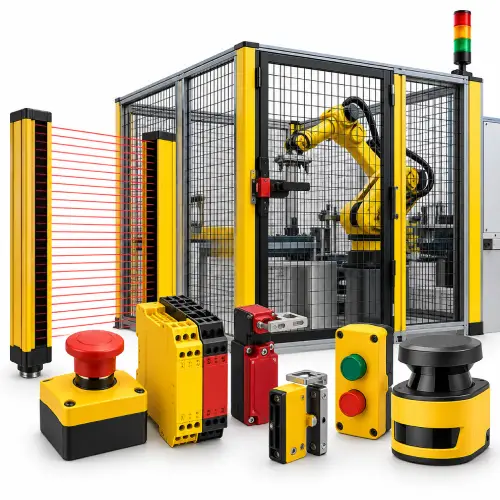
Yuva Solution can support requirements involving different safety technologies and machine-protection arrangements.
- Safety Guarding
Physical barriers can restrict access to hazardous machine areas while allowing operators to carry out necessary production activities.
- Guard Interlocking
Interlocking can connect access doors or guards with the machine’s safety system so that defined machine functions are prevented or stopped when the protective access condition is not satisfied.
- Safety Sensors
Sensors can detect selected safety-related conditions, such as opening of a guarded area or entry into a protected zone.
- Emergency-Stop Systems
Emergency-stop devices can provide a readily accessible method of initiating the designated emergency response.
- Safety Light Curtains
Photoelectric protective devices can monitor defined access areas where suitable machine stopping characteristics allow their use.
- Safety Relays and Controllers
Safety-related control components can process signals from protective devices and provide the required safety outputs as part of the engineered machine-safety system.
A Different Way to Look at Machine Safety
Machine safety should not be viewed as something added after the machine has already been designed.
A better approach is to consider safety throughout the machine’s operating lifecycle:
Design → Installation → Commissioning → Operation → Maintenance → Modification
This is particularly important because a machine can have different risks during production, setup, cleaning, adjustment, troubleshooting, and maintenance.
The ILO also emphasizes considering machinery suitability, safeguards, maintenance, and safe working procedures as part of the overall machinery-safety approach.
What Makes Our Approach Different?
Instead of simply recommending individual safety components, Yuva Solution focuses on how those components fit into the machine.
For example:
Machine Hazard → Protective Measure → Detection → Safety Logic → Controlled Response
This creates a more logical connection between the identified hazard and the safety function designed to address it.
The exact solution depends on the machine’s construction, operating cycle, hazardous energy, access requirements, stopping characteristics, and applicable safety requirements.
Machine Safety for Automated Equipment
Automation can increase production speed and reduce manual intervention, but automated movement can also introduce additional hazards. Robots, conveyors, actuators, presses, drives, and other equipment may continue moving automatically unless the safety system is designed to respond appropriately.
A machine-safety architecture can therefore work alongside the normal automation system.
For example:
Safety Device → Safety Controller → Safety Output → Machine Safe State
while the standard automation controller continues to manage the normal production sequence.
This separation between ordinary process control and safety-related functions is an important consideration in machine-safety engineering.
Technical Considerations
There is no universal technical specification for Machine Safety because the required arrangement depends on the equipment being protected.
Consideration | Requirement |
Machine Type | CNC / Conveyor / Robot / Press / Packaging / Other |
Hazard Type | Mechanical / Electrical / Motion / Other |
Protection Method | Guard / Sensor / Interlock / Light Curtain / Other |
Safety Input | Device-specific |
Safety Logic | Relay / Safety Controller / Integrated System |
Safety Output | Contactor / Drive / Actuator / Other |
Machine Stop Time | Application specific |
Access Points | Based on machine layout |
Safety Zones | Based on hazard distribution |
Operating Modes | Automatic / Manual / Setup / Maintenance |
Environmental Conditions | Temperature / Dust / Moisture / Vibration |
Safety Performance | Based on risk assessment |
The required safety performance and component selection should be determined through appropriate engineering and risk assessment rather than assumed from a generic product specification.
Designed for Real Industrial Conditions
Industrial machinery rarely operates in a perfect environment. Dust, vibration, repeated access, temperature changes, production pressure, cleaning procedures, and maintenance activities can all influence how a safety arrangement performs.
Therefore, practical machine safety should consider:
- Accessibility
Operators should be able to perform required tasks without creating unnecessary exposure to hazardous areas.
- Visibility
Where appropriate, guards and protective arrangements should allow operators to understand the machine’s operating condition.
- Maintenance
Safety arrangements should accommodate necessary inspection, servicing, and maintenance activities.
- Reliability
Safety components should be appropriately selected and installed for their intended application.
- Usability
A safeguard that unnecessarily obstructs normal work may encourage unsafe bypassing or improper use. Good safeguarding should provide protection without creating unnecessary interference.
Applications Across Industries
Machine safety solutions can be considered for:
- CNC machinery
- Robotic production cells
- Packaging machines
- Conveyor systems
- Press machines
- Assembly equipment
- Material-handling machinery
- Printing machines
- Automotive production lines
- Pharmaceutical machinery
- Food-processing equipment
- Textile machinery
- Engineering workshops
- Automated manufacturing plants
Why Choose Yuva Solution?
Yuva Solution provides machine-safety products and solutions for customers in Kolkata, Bihar, Odisha, Jharkhand, Chhattisgarh, and Assam.
The company can assist customers in identifying suitable safety products according to the machine’s operating conditions rather than treating every application identically.
Requirements may include:
- Machine safety sensors
- Safety interlocks
- Safety light curtains
- Safety relays
- Safety controllers
- Emergency-stop solutions
- Machine guarding requirements
- Safety-system integration
Yuva Solution can work around both new machine installations and selected machine-modernization requirements.
Machine Safety for New and Existing Equipment
Machine safety is relevant not only when purchasing a new machine. Existing equipment may also require review when it is modified, automated, relocated, upgraded, or integrated with new machinery.
For older machines, the available control architecture and existing protective arrangements should be assessed before selecting additional safety equipment.
A machine-safety upgrade may involve adding appropriate guarding, access monitoring, sensing devices, or safety-control components depending on the identified requirement.
A Practical Machine-Safety Philosophy
The strongest machine-safety approach begins with understanding what can cause harm, who can be exposed, when exposure can occur, and what protective response is required.
Physical safeguarding remains an important part of this process. Where fixed guards are not practical, suitable interlocks, presence-sensing devices, or other protective methods may be considered. This makes Machine Safety more than a product category—it becomes an engineered part of the machine itself.
Frequently Asked Questions
Machine Safety is the systematic approach to identifying and reducing risks associated with machinery through suitable design measures, guards, protective devices, safety controls, and safe operating practices.
Depending on the application, products can include safety sensors, interlocks, light curtains, emergency stops, safety relays, safety controllers, and physical guarding.
Yes, selected existing machines can be upgraded with additional safeguarding and safety-control equipment after evaluating the machine and its hazards.
Not necessarily. A safety sensor is only one part of a complete safety arrangement. Its suitability depends on the hazard, placement, stopping characteristics, safety logic, and overall machine design.
Yes. Machine-safety functions can be designed to work alongside PLCs, drives, robots, HMIs, and other automation equipment.
Yuva Solution serves customers across Kolkata, Bihar, Odisha, Jharkhand, Chhattisgarh, and Assam.
Contact Yuva Solution
If you are looking for a Machine Safety Manufacturer for a new automated machine, existing production equipment, robotic cell, conveyor, CNC machine, or industrial automation project, Yuva Solution can help you identify suitable safety products and system requirements. Contact Yuva Solution to discuss your machine type, hazardous areas, existing safety devices, automation system, and required protection arrangement.
Frequently Asked Questions
Machine Safety is the systematic approach to identifying and reducing risks associated with machinery through suitable design measures, guards, protective devices, safety controls, and safe operating practices.
Depending on the application, products can include safety sensors, interlocks, light curtains, emergency stops, safety relays, safety controllers, and physical guarding.
Yes, selected existing machines can be upgraded with additional safeguarding and safety-control equipment after evaluating the machine and its hazards.
Not necessarily. A safety sensor is only one part of a complete safety arrangement. Its suitability depends on the hazard, placement, stopping characteristics, safety logic, and overall machine design.
Yes. Machine-safety functions can be designed to work alongside PLCs, drives, robots, HMIs, and other automation equipment.
Yuva Solution serves customers across Kolkata, Bihar, Odisha, Jharkhand, Chhattisgarh, and Assam.