Product Profile
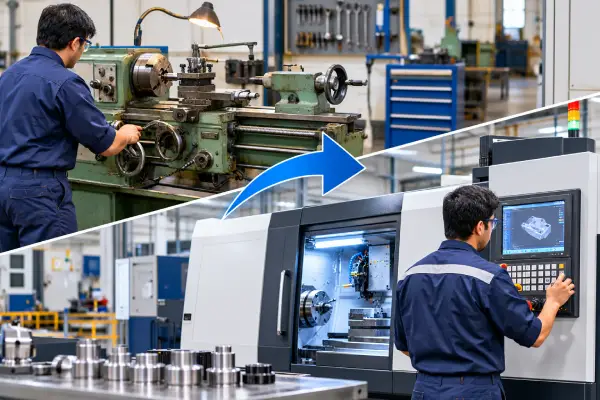
Conventional to CNC Conversion is an effective method of upgrading traditional manually operated machines with modern computer numerical control technology. Instead of replacing an existing machine completely, selected mechanical, electrical, and control systems can be upgraded to introduce CNC-based operation.
Yuva Solution provides Conventional to CNC Conversion solutions for industries that want better machining control, repeatability, productivity, and operator convenience while continuing to use their existing machine structure.
The conversion may involve CNC controllers, servo motors, drives, encoders, electrical panels, operator interfaces, sensors, machine wiring, and other control components depending on the machine type and required performance.
Yuva Solution provides CNC conversion solutions across Kolkata, Bihar, Odisha, Jharkhand, Chhattisgarh and Assam.
Key Features of Conventional to CNC Conversion
- CNC-Based Machine Control: Enables programmed control of machine movements instead of relying entirely on manual operation.
- Servo System Integration: Servo motors and drives can provide controlled movement and positioning.
- Digital Operator Interface: A modern CNC interface makes machine operation and parameter management more convenient.
- Position Feedback: Encoders and related feedback devices help monitor axis movement and positioning.
- Programmable Machining: CNC programs can be used for repetitive machining operations.
- Electrical Modernization: Old control wiring and panels can be reorganized or upgraded according to the new CNC system.
- Safety Integration: Suitable safety controls can be incorporated during the conversion process.
Why Convert a Conventional Machine into CNC?
Converting an existing machine can be a practical choice when its mechanical foundation is still usable but its manual control system limits production requirements.
A CNC conversion can help manufacturers achieve more consistent machine operation and reduce dependence on continuous manual adjustments. It can also provide greater flexibility for producing repeated components and handling more complex machining sequences.
For businesses with valuable conventional machinery, conversion may offer a way to modernize the equipment without investing in an entirely new CNC machine.
Better Control for Precision Manufacturing
CNC technology allows programmed movements to be controlled through a dedicated numerical control system. With appropriate mechanical condition, drive selection, feedback, and commissioning, converted machinery can achieve improved repeatability compared with purely manual operation.
Yuva Solution evaluates the machine before conversion to determine whether the existing mechanical arrangement is suitable for CNC operation. This assessment helps establish an appropriate conversion scope.
Upgraded Components for Long-Term Operation
A CNC conversion requires more than installing a CNC controller. The controller, servo drives, motors, feedback devices, electrical panel, spindle arrangement, sensors, and machine mechanics need to work together as one system.
Yuva Solution focuses on suitable component selection and systematic integration so that the upgraded machine remains practical for production and future maintenance.
Conventional to CNC Conversion Across Eastern and Central India
Yuva Solution provides Conventional to CNC Conversion solutions for industrial customers in Kolkata, Bihar, Odisha, Jharkhand, Chhattisgarh and Assam. The conversion approach can be adapted to different machine sizes, axis configurations, control requirements, and production conditions. Whether an organization wants to modernize an older machine for improved productivity or needs CNC control for repetitive machining work, the conversion can be planned around its actual operational requirements.
Why Choose Yuva Solution for CNC Conversion?
Selecting the right conversion partner is important because CNC modernization involves both machine mechanics and automation technology. Yuva Solution considers the condition of the existing equipment, required machine functions, control architecture, electrical requirements, and intended production use before implementing the conversion.
The focus is on delivering a practical CNC upgrade rather than simply adding a new controller to an old machine. Proper integration, wiring, testing, parameter configuration, and commissioning help create a more dependable converted machine.
Cost-Effective Alternative to Complete Machine Replacement
A conventional machine may still have a strong mechanical structure even when its control system has become outdated. In such situations, replacing the complete machine may not always be necessary.
Conventional to CNC Conversion allows manufacturers to retain suitable parts of their existing equipment while investing in modern control and automation components. This approach can provide a balanced path between continuing with manual operation and purchasing a completely new CNC machine.
Reliable CNC Conversion Support
From initial machine assessment to control integration, electrical modification, testing, and commissioning, Yuva Solution aims to provide structured support throughout the CNC conversion process. For companies seeking a Conventional to CNC Conversion solution in Kolkata, Bihar, Odisha, Jharkhand, Chhattisgarh and Assam, Yuva Solution offers an industrial modernization approach designed around the machine’s actual requirements and intended production performance.