Key Reasons to Choose This Product
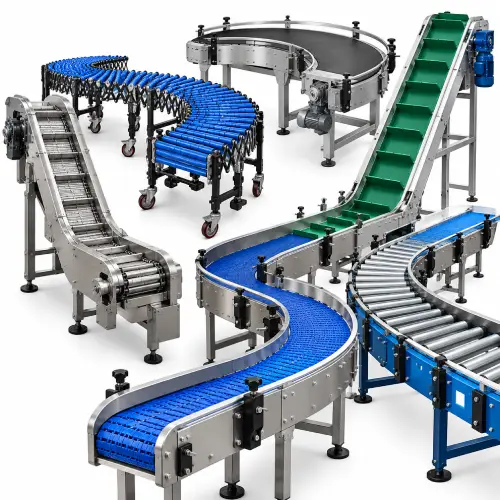
Special Type Conveyors can provide useful advantages where standard conveyor arrangements are not appropriate.
- Designed around specific handling requirements
- Adaptable to different industrial layouts
- Suitable for customized conveying routes
- Helps maintain a continuous material flow
- Can be configured for different product sizes
- Useful where floor space is limited
- Can be integrated with existing equipment
- Reduces unnecessary manual material movement
- Supports organized transfer between workstations
- Suitable for specialized production and handling operations
Technical Specifications
The specifications of a special conveyor depend on the material and application for which it is required. Yuva Solution can configure the equipment according to project requirements.
| Specification | Available Configuration |
| Conveyor Type | Application-specific |
| Conveyor Length | As per requirement |
| Conveyor Width | As per material and layout |
| Conveyor Height | Fixed or application-based |
| Drive Arrangement | Selected according to load and duty |
| Conveyor Surface | Belt, roller, or other suitable arrangement |
| Frame Construction | Industrial-duty fabricated structure |
| Material Handling | Customized according to product |
| Direction of Movement | According to system layout |
| Control System | Manual, electrical, or integrated control |
| Installation | Customized for site conditions |
Final dimensions and operating parameters can be determined after reviewing the material, throughput, layout, and working conditions.
Common Applications
Special Type Conveyors can be used in several areas where materials need to follow a particular movement path or transfer process.
Common applications include:
- Manufacturing units
- Engineering industries
- Automobile component plants
- Warehouses
- Packaging facilities
- Assembly lines
- Distribution centers
- Material transfer stations
- Production and processing areas
- Dispatch sections
- Industrial storage facilities
- Customized automation lines
They are particularly useful for applications requiring a conveyor arrangement that cannot be achieved effectively with a basic straight conveyor.
Quality You Can Trust
Yuva Solution gives importance to the construction, movement performance, and suitability of every conveyor supplied for an industrial application. Components are selected according to the expected operating conditions, load requirements, and intended usage.
Attention is given to the conveyor structure, drive arrangement, conveying surface, supporting components, and overall system configuration. Proper selection of these elements helps create a conveyor that can perform consistently under regular industrial operating conditions.
Quality checks and application-based design considerations help ensure that the finished equipment is suitable for its intended purpose.
Why Choose this company?
Choosing the right conveyor manufacturer is important when the equipment needs to work within a specific production or handling environment. Yuva Solution provides application-focused solutions instead of treating every requirement as a standard conveyor project.
Customers can approach the company for customized conveyor requirements, layout-based solutions, and specialized material movement applications. Our team considers the operating objective and site requirements before finalizing the conveyor configuration.
Key advantages of working with Yuva Solution:
- Application-oriented conveyor design
- Customized equipment options
- Industrial material handling expertise
- Practical approach to conveyor layouts
- Support for different handling requirements
- Service coverage across eastern and central Indian regions
- Focus on dependable industrial equipment
Infrastructure and Industrial Uses of Special Type Conveyors
Special Type Conveyors can become an important part of industrial infrastructure where materials need to move between different sections of a facility. They can connect production machinery, storage areas, packing stations, inspection points, and dispatch zones.
In manufacturing infrastructure, customized conveyors may be used to transfer components between workstations. In warehouses, they can support organized movement between storage and packing areas. In packaging operations, they can help maintain a steady flow of products toward subsequent processing or dispatch stages.
Their ability to follow customized layouts also makes them useful in facilities where available floor space, machinery positioning, or existing structures restrict the use of conventional conveyor systems.