
Communication Cables Manufacturer
Introduction to Our Communication Cables
Industrial equipment depends on stable data transmission to exchange information between controllers, sensors, computers, drives, monitoring systems, and other connected devices. Communication Cables provide the physical pathway through which digital or serial signals travel between industrial equipment.
Yuva Solution is a Communication Cables Manufacturer serving industrial requirements across Kolkata, Bihar, Odisha, Jharkhand, Chhattisgarh, and Assam.
Unlike ordinary electrical cables that primarily carry power, communication cables are designed to transmit information. Their construction, shielding, conductor arrangement, insulation, impedance, and transmission characteristics are selected according to the communication technology and installation environment.
What Are Communication Cables?
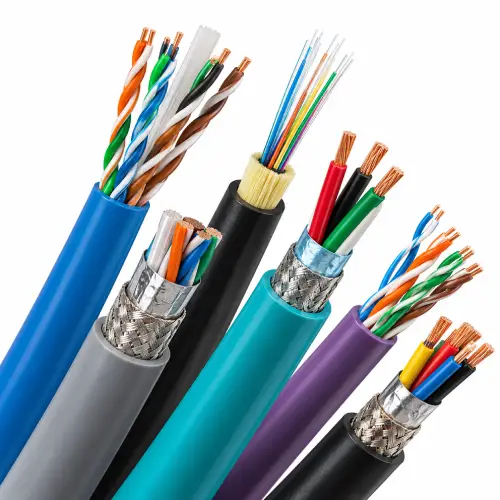
Communication cables are specialized cables used for transferring data and signals between electronic and industrial devices. They can be found in automation panels, manufacturing lines, control rooms, instrumentation systems, building networks, and machine-to-machine communication applications.
Depending on the system, communication cabling may be used with Ethernet networks, serial interfaces, fieldbus systems, instrumentation networks, or other industrial communication arrangements.
A suitable cable can help maintain signal integrity over the required distance and reduce the possibility of communication problems caused by electromagnetic interference or unsuitable installation conditions.
Types of Communication Cables
Different industrial networks require different cable constructions. Common categories include:
Industrial Ethernet Cables
These cables are used for Ethernet-based communication between industrial devices such as PLCs, switches, industrial PCs, HMIs, and other network equipment.
Fieldbus Cables
Fieldbus cables are designed for specific industrial communication systems where controllers and field devices exchange process information over a dedicated network.
Serial Communication Cables
Serial cables can be used for communication between compatible devices using interfaces such as RS-232, RS-422, or RS-485.
Shielded Communication Cables
Shielding can help reduce the effect of electrical interference in environments containing motors, drives, contactors, transformers, and other sources of electromagnetic disturbance.
Multi-Pair Communication Cables
Multi-pair constructions are useful where several communication circuits need to be carried within a common cable arrangement.
The exact cable type should be selected according to the communication protocol, equipment interface, distance, environment, and installation method.
Construction of Communication Cables
The performance of a communication cable depends on more than the outer jacket. Several elements work together to provide appropriate signal transmission.
Typical construction may include:
- Copper conductors
- Insulating material
- Individual pair insulation
- Twisted-pair arrangement
- Shielding layer
- Drain wire where applicable
- Inner and outer protective layers
- Industrial-grade outer sheath
The conductor size, insulation material, shielding arrangement, pair construction, and jacket material can vary according to the cable design.
Where Communication Cables Are Used
Communication cables can be installed in many industrial and commercial environments, including:
- PLC control systems
- Factory automation
- SCADA networks
- HMI communication
- Industrial Ethernet networks
- Instrumentation systems
- Process-control installations
- Machine automation
- Robotics
- Packaging machinery
- Production lines
- Data acquisition systems
- Building automation
- Industrial monitoring networks
Communication Cables for Industrial Environments
Factory-floor conditions can be considerably more demanding than conventional office environments. Communication cables may be exposed to electrical noise, mechanical movement, vibration, oil, dust, moisture, temperature changes, or repeated bending.
For dynamic machinery, cable flexibility can be an important consideration. For fixed installations, mechanical protection and appropriate routing may receive greater attention.
Where cables are installed near power cables, motors, or variable-frequency drives, shielding and proper separation can be important considerations for maintaining communication quality.
Factors to Consider Before Selecting a Communication Cable
Choosing a communication cable should begin with identifying the actual network requirement.
- Communication Protocol
The cable must be suitable for the communication standard or network technology being used.
- Transmission Distance
Longer communication runs may have different cable requirements compared with short machine-level connections.
- Data Rate
Higher-speed communication may require cable constructions designed for the required transmission performance.
- Electrical Interference
Industrial environments containing motors and power equipment may require shielded cables or appropriate installation practices.
- Mechanical Conditions
Movement, bending, vibration, pulling, and installation method can influence cable selection.
- Environmental Exposure
Temperature, moisture, chemicals, oil, dust, and outdoor exposure should be considered where applicable.
Why Communication Cable Quality Matters
A communication network can contain high-quality controllers and switches, but poor cabling can still affect overall network performance.
An unsuitable cable may contribute to:
- Intermittent communication
- Signal attenuation
- Data transmission errors
- Network instability
- Unexpected communication loss
- Maintenance difficulties
Selecting a cable that matches the network specification helps establish a dependable physical communication layer.
Communication Cables for Automation & IoT Networks
Industrial automation and IoT applications are increasingly connected. Machines generate information that may need to travel from field devices to controllers, local networks, monitoring systems, and higher-level data platforms.
Communication cables can support this information flow by connecting equipment within the industrial network.
For example:
Sensor/Device → Controller → Communication Network → Industrial Computer/SCADA → Data System
The cable is one part of this complete communication path, making appropriate cable selection important when designing or upgrading an industrial network.
Technical Specifications
The specifications of communication cables vary according to their construction and intended application.
| Parameter | Typical Specification Consideration |
| Cable Type | Ethernet / Fieldbus / Serial / Multi-pair |
| Conductor | Copper or application-specific conductor |
| Conductor Size | Application dependent |
| Pair Configuration | Single or multi-pair |
| Shielding | Unshielded / Shielded |
| Insulation | According to cable design |
| Outer Sheath | Industrial or application-specific |
| Communication Speed | Network dependent |
| Operating Voltage | Model/application dependent |
| Operating Temperature | Cable construction dependent |
| Installation | Fixed / Flexible / Machine application |
| Length | As required by installation |
| Connector | Application and equipment dependent |
Exact technical parameters should be confirmed according to the required communication protocol and installation conditions.
Applications Across Different Industries
Yuva Solution’s communication cable solutions can be considered for:
- Manufacturing: Connecting controllers, machines, HMIs, and network equipment.
- Process Industries: Supporting communication between automation and monitoring equipment.
- Power & Utilities: Connecting control and monitoring systems.
- Packaging: Linking machine controllers, sensors, drives, and operator interfaces.
- Material Handling: Supporting communication across conveyors, sorting systems, and automated equipment.
- Industrial IoT: Providing physical connectivity between connected equipment and data acquisition systems.
Why Choose Yuva Solution?
Yuva Solution supplies communication cable solutions for industrial automation, networking, and data-transfer requirements across Kolkata, Bihar, Odisha, Jharkhand, Chhattisgarh, and Assam.
The company focuses on understanding the application before recommending a cable. Factors such as network type, distance, environment, equipment interface, shielding requirement, and installation conditions can be considered during product selection.
Customers can approach Yuva Solution for:
- Industrial communication cables
- Automation networking requirements
- Shielded communication cables
- Ethernet connectivity
- Fieldbus communication requirements
- Serial communication cables
- Industrial IoT connectivity
- Cable selection assistance
Frequently Asked Questions
A communication cable is designed to transmit data or signals between compatible electronic, automation, networking, or industrial devices.
Yes. Power cables are primarily designed to carry electrical power, whereas communication cables are designed around the requirements of signal and data transmission.
Shielding can help reduce electromagnetic interference, particularly in industrial environments where motors, drives, and power equipment operate close to communication wiring.
Yes. Depending on the PLC interface and communication technology, suitable communication cables can connect PLCs with HMIs, switches, remote devices, computers, and other automation equipment.
Yes. Transmission distance is an important consideration because different communication technologies and cable types have specific distance and performance characteristics.
Yuva Solution serves customers across Kolkata, Bihar, Odisha, Jharkhand, Chhattisgarh, and Assam.
Choose the Right Communication Cable for Your Network
A dependable industrial network starts with appropriate physical connectivity. Whether the requirement involves a machine-level automation network, industrial Ethernet, fieldbus communication, serial devices, or an IIoT installation, the cable should be selected according to the complete application rather than simply by appearance or price.
Yuva Solution provides communication cable solutions for industrial customers seeking dependable connectivity across Kolkata, Bihar, Odisha, Jharkhand, Chhattisgarh, and Assam. Contact Yuva Solution to discuss your communication protocol, cable length, installation environment, and equipment requirements.