
Tunnel Ventilation System Manufacturer
Product Profile
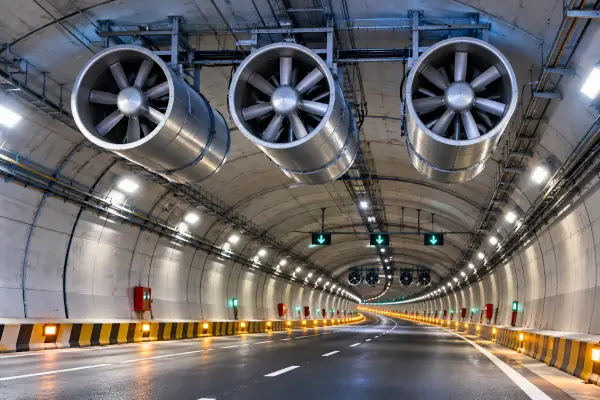
A Tunnel Ventilation System is an engineered arrangement used to control and manage airflow inside tunnels. It helps move fresh air through the tunnel, remove contaminated air, and maintain suitable environmental conditions for people, vehicles, and equipment.
In modern infrastructure, tunnel ventilation can be integrated with electrical control, sensors, automation systems, variable frequency drives, fans, and monitoring platforms. The control strategy can be designed according to tunnel length, traffic conditions, ventilation requirements, equipment capacity, and the overall project design. Yuva Solution provides automation and control solutions for Tunnel Ventilation System Manufacturer across Kolkata, Bihar, Odisha, Jharkhand, Chhattisgarh, and Assam.
Key Features of Tunnel Ventilation System
A properly planned tunnel ventilation arrangement can incorporate several control and monitoring features depending on the project.
- Automated fan operation
- Centralized ventilation monitoring
- Variable speed fan control
- Sensor-based monitoring
- Equipment status indication
- Alarm and fault monitoring
- Manual and automatic operating modes
- PLC-based control
- HMI or SCADA supervision
- Industrial communication
- Sequential equipment operation
- Emergency operating provisions as specified by the project
The actual configuration depends on the tunnel design, ventilation philosophy, equipment selection, and applicable engineering requirements.
How Does a Tunnel Ventilation System Work?
The basic purpose of tunnel ventilation is to control the movement of air within an enclosed underground or semi-enclosed passage.
Fans and associated equipment create or manage airflow through the tunnel. Sensors and monitoring devices can provide information about environmental or operational conditions. A control system can then use programmed logic to operate the ventilation equipment according to the defined operating strategy.
In an automated arrangement, operators may be able to monitor fan status, equipment conditions, selected sensor values, alarms, and operating modes from a centralized interface.
Top Benefits of Choosing an Automated Tunnel Ventilation Solution
Automation adds an intelligent control layer to the ventilation infrastructure.
Key benefits can include:
- Better visibility of ventilation equipment
- Centralized monitoring
- Automated fan sequencing
- Flexible speed control
- Faster identification of equipment faults
- Reduced need for repetitive manual operation
- Event and alarm monitoring
- Better coordination between ventilation equipment
- Easier operator supervision
- Integration with wider tunnel control systems
The actual performance depends on the ventilation design, fan capacity, sensor arrangement, control logic, and installation conditions.
Control Architecture for Tunnel Ventilation
A tunnel ventilation automation system may combine field devices, controllers, drives, operator interfaces, and communication networks.
A typical architecture may include:
Field Sensors → PLC / Controller → VFD & Fan Control → HMI / SCADA
Additional equipment can be integrated according to project requirements. This architecture allows information from the field to reach the control system while providing operators with a means to monitor and manage connected ventilation equipment.
Tunnel Ventilation Monitoring & Control
Continuous monitoring is important when multiple fans and ventilation zones are involved. A centralized control system can display operating conditions and equipment status in an organized format.
Depending on the project, monitoring may cover:
- Fan running status
- Fan fault status
- Motor parameters
- Airflow-related measurements
- Environmental sensor inputs
- Ventilation zone status
- Control mode
- Alarm conditions
- Equipment availability
This information can assist operators in understanding the current condition of the ventilation system.
Intelligent Fan Control for Tunnel Applications
Fans are among the most important components of a tunnel ventilation arrangement. Operating every fan at full capacity at all times may not be appropriate for every operating condition.
Where the engineering design permits, variable frequency drives can be used to regulate motor speed. Automation logic can coordinate fan operation according to predefined conditions and operating requirements.
This approach can provide greater flexibility in managing ventilation equipment while allowing the system to respond to changing operating conditions.
Safety-Oriented Ventilation Monitoring
Tunnel environments can present changing operating conditions, particularly in road, rail, and infrastructure applications. Therefore, ventilation systems may need monitoring and predefined operating responses for different scenarios.
An automation system can support alarm generation, equipment status monitoring, emergency operating sequences, and centralized supervision as specified by the project engineering and safety philosophy.
The ventilation control system should always be developed in accordance with the applicable tunnel design, safety standards, emergency strategy, and authority requirements.
Applications Across Business Verticals
Tunnel ventilation systems and their automation can be used in different infrastructure environments, including:
- Road tunnels
- Highway tunnels
- Railway tunnels
- Metro tunnels
- Underground transportation systems
- Mining tunnels
- Industrial underground passages
- Utility tunnels
- Long enclosed infrastructure corridors
- Underground industrial facilities
Each application may require a different ventilation strategy depending on tunnel geometry, traffic, equipment, environmental conditions, and emergency requirements.
What Makes Yuva Solution a Trusted Name
Yuva Solution provides industrial automation and control solutions for applications where equipment monitoring and coordinated operation are important.
For tunnel ventilation projects, our approach can involve integrating PLCs, drives, sensors, control panels, HMI, SCADA, and industrial communication according to the project’s requirements.
Our approach focuses on:
- Understanding the ventilation process
- Developing application-specific control logic
- Integrating field equipment
- Providing centralized monitoring
- Supporting drive and motor control
- Creating suitable operator interfaces
- Considering future system expansion where required
Affordable Tunnel Ventilation System Solutions
Every tunnel project has different requirements. The cost of a ventilation automation system can depend on the number of fans, motor ratings, sensor requirements, control panels, communication infrastructure, PLC/SCADA architecture, and project complexity.
Yuva Solution focuses on providing practical and application-oriented solutions rather than using an identical configuration for every project.
Customers can discuss their tunnel length, number of ventilation units, fan ratings, sensor requirements, control philosophy, and existing infrastructure to determine a suitable system configuration.
Reliable Support for Tunnel Ventilation System
A ventilation control system requires proper coordination between electrical, mechanical, instrumentation, and automation elements. Yuva Solution works with customers to understand these requirements before determining the appropriate control arrangement.
Our solutions can be considered for new installations as well as automation upgrades and modernization projects, subject to site and system requirements.
Where Can Tunnel Ventilation Automation Be Used?
Tunnel ventilation automation is particularly useful where several fans, ventilation zones, sensors, and control devices need to be monitored from one operating environment.
It can support projects involving:
- Transportation infrastructure
- Metro construction
- Railway infrastructure
- Highway development
- Mining infrastructure
- Underground industrial projects
- Large enclosed passages
Why Choose Yuva Solution for Tunnel Ventilation System?
Yuva Solution combines industrial automation knowledge with application-focused engineering to support tunnel ventilation control requirements.
Customers can benefit from:
- Customized automation architecture
- PLC-based control solutions
- HMI and SCADA integration
- VFD-based fan control
- Sensor integration
- Centralized monitoring
- Industrial communication solutions
- Application-specific programming
- Support for new and modernization projects
Serving Tunnel Ventilation Requirements Across Eastern India
Yuva Solution provides Tunnel Ventilation System automation and control solutions for customers across Kolkata, Bihar, Odisha, Jharkhand, Chhattisgarh, and Assam.
Our solutions are suitable for infrastructure companies, engineering contractors, system integrators, industrial organizations, and project developers requiring automated ventilation monitoring and control.
Frequently Asked Questions
A tunnel ventilation system is an arrangement of fans, ducts or airflow paths, sensors, controls, and associated equipment used to manage air movement within a tunnel.
Automation helps operators monitor ventilation equipment and can control fans according to predefined operating sequences and project-specific conditions.
Yes, VFDs can be used for suitable fan motors where variable-speed operation is included in the system design.
Yes. SCADA can provide centralized supervision of suitable ventilation equipment, alarms, operating status, and selected field parameters.
Yes. Yuva Solution provides automation and control solutions for tunnel ventilation applications across Kolkata, Bihar, Odisha, Jharkhand, Chhattisgarh, and Assam.
Discuss Your Tunnel Ventilation Requirement
Whether it is a road tunnel, railway project, metro infrastructure, mining application, or another enclosed facility, the ventilation control system should be planned according to the project’s airflow requirements, equipment configuration, safety philosophy, and operating conditions. Yuva Solution provides application-focused Tunnel Ventilation System automation and control solutions across eastern India.